8 training routines to boost climbing performance
Climbing harder is easy. There's an industry built around telling you it's not. All you need is to climb three times a week, stretch, stop fearing falls, eat and sleep well, keep a healthy weight, and find a partner who's got your back.
Andy, as usual, is not wrong. In fact many of the go to training plans of top climbers are really just structured climbing sessions. This article will explore some of these and the nuance around training, including some methods to maximise effort to return. The article will also have good options for those who are time poor, don't have easy access to a good wall or lack a partner with a compatible schedule.
Many of the below training plans and tips come from super strong climbers (ie. The best in the world). However this article is aimed at the climber who dreams of doing a long 10+ pitch route or pushing into the low E grades of trad climbing (maybe both together). So a lot, but not all, the plans are skewed towards endurance.
Injury prevention
One of the first people to climb 9a, Wolfgang Güllich, once said:
It's all about getting strong without getting injured. If you are injured you can not train and
can not climb.
Building up training difficulty and intensity slowly over several months can help give the body time to adapt and strengthen, thus reducing the chance of injury.
Having good form is also very important. As you get tired, your form can suffer and the chance of injury can increase. Be mindful of this, especially when doing higher intensity training.
Is 3 times a week enough?
Probably yes. If you're not pushing to be world class. 2 to 4 good sessions of the right intensity, quality and duration, if done consistently, will make a great climber out of most people. to quote Dave MacLeod:
Consitency is the most important word in training
Of course, this only opens more questions: what's the right quality, the right duration or intensity? The answer to that comes down to understanding the weakness that needs addressing with a person's climbing, and also what their goals are.
Why do you fall off?
If your forearms fill with lactic acid badly i.e. you get "pumped", your performance will rapidly drop until you can't hold on or make a move. In this scenario then endurance is likely the main issue.
Alternatively if your grip fails, or your ability to pull up is not enough, (but you're not pumped) then you lack strength.
General climbing with enough volume and difficulty will improve both of these, but there are some routines below to help build endurance and / or strength in an efficient way. Some of these plans can also help those who can't get onto real rock or even a decent climbing gym regularly.
The sessions I find most helpful / enjoyable.
Ordered from the longest training routines to the shortest, these are 8 routines I've used to support climbing improvements.
#1. Three x 40min Circuits
- ✅Very good for endurance
- ✅Simple
- ✅Helps climbing technique
- 🛑Finding a good circuit isn't easy
- 🛑Time consuming at ~3 hours
- 🛑A bit boring
This is a beast of an endurance workout, and as Dave Macleod performs it, it's better suited to professional climbers or the super serious, but adjusting the time, at least initially, can make it accessible to more people.
Essentially you find a bouldering circuit and do three x 40 minute (or perhaps 20min to start with) continuous laps with rests in between. Dave recommends several grades below your max. His circuit is 6b, which for a 9a climber is many grades down. For many normal climbers it might be a matter of finding the easiest circuit and seeing if you can last for close to 40 minutes.
Using real rock should help protect your hands from the excessive abrasion that can happen with synthetic holds. That's not to mention, hogging a section of a climbing wall for 3 hours, might not be well received.
The main challenge with this is finding something sufficiently hard, that you are also able to do for 40 minutes. Starting with a bit less time for many will make sense. If you watch the video of Dave's spot, he has a circuit that offers some challenge and some recovery/rest opportunities within the circuit.
An beginner friendly alternative:
At an indoor gym, climbing up and down easy problems and traversing to the next can achieve the same result and not hog one section of the gym for hours. This is also a bit more interesting.
#2. 4 x 4 x 4 boulders
- ✅Great for endurance
- ✅Works in smaller gyms
- ✅Helps climbing technique
- ✅Trains strength and power
- 🛑A bit borning
- 🛑Typically well over 2 hours
A routine Adam Ondra talks about using involves climbing 64 boulder problems, or more precisely 16 different boulder problems 4 times. The method is to find 4 problems, climb each of them, rest for a minute and repeat 3 more times (16 ascents), then rest some more (a little longer) and repeat with a different 4 problems to make 4 sets of 4 climbs done 4 times. This is a serious endurance workout and like Dave MacLeods workout, it requires you to pick the right level of difficulty so you can only just get through it. But unlike Dave's it's typically done in a gym which is a little safer, easier to access and makes the odd fall acceptable.
It's easy enough to do (from a set up perspective), even in a small gym, but it is a bit boring so not a format I use a lot, however it will seriously train endurance.
A less boring alternative:
An alternative I use quite a lot, is to start with the easiest problem in a gym, do and everything of the same grade then move to the next grade and so on, essentially trying to tick every problem in the gym. When you max out or run out of routes you could go backwards. This is a more fun way to get to 64 boulder problems and because it starts at the easiest routes in the gym up to the hardest (you can do), it's a very complete endurance workout. It will have a lot of variety and it's very satisfying to do half or even 3 quarters of the routes in a gym in a single session.
#3. Sport doubles
- ✅Great for endurance
- ✅Simple
- ✅Helps climbing technique
- ✅Not too time consuming at 1 to 2h
- ✅Helps leading technique
- 🛑Need a belay partner
- 🛑Needs lead wall with right grades
Stefano Ghisolfi's simple but effective routine is to warm up on 2 or 3 sport routes then do 2 hard routes (close to your max grade) back to back with 15mins rest repeated 3 or even 4 times (not necessarily the same routes). Whilst you could use an auto belay without a partner, this will reduce the benefit by a reasonable margin (you may therefore want to do 3 routes back to back rather than 2).
Although there is structure to this training plan, much like Dave and Adams sessions above, it does look a lot like "just climbing". Stefano is really just optimising for improving endurance whilst not neglecting technique and some power as the routes are close to a person's max grade. This optimises for a bit more than endurance and is a bit shorter than the full sessions from Adam and Dave above making it a good one if you only have 90mins or so.
#4. Circuits with clips
- ✅Great for endurance
- ✅Helps climbing technique
- ✅Not too time consuming at 20 - 60mins+
- ✅Helps leading technique
- 🛑Needs a specific set up
This is another unusual but highly effective routine from Stefano, for building endurance I find very useful for trad climbing.
Find a bouldering wall where you can also practice clipping, not because you need practice clipping but because the act of clipping means you have to hold on one armed for an extended period, something you will do a lot when climbing outside.
You will need to have either a home wall you can add quick draws to, an outside boulder location you can place gear in or bring some gear to a gym and hope no one minds. Hanging or hitching a sling to jugs with a dangling carabiner is the easiest option. Most gyms won't let you boulder with a harness (presumably in case a gear loop snags a jug and you take a bad / inverted fall), therefore just tie a couple of meters or rope/cord around your waist and let it dangle. As you do the circuits aim to clip every 4/5 moves and you will find the circuit feels much harder.
This is a routine I love doing because you also need to think about your positioning and how to move efficiently. So whilst it's training endurance, it's also helping with quite a lot more useful stuff as well.
The obvious challenge with this is finding somewhere you can practice it. An alternative is to just hold on one armed for 4 or 5 seconds every 4 or 5 moves. However this is not quite the same because clipping, like placing gear, is not a static rest, you need to hold and move through positions that might not be optimal, which is the beauty of this routine.
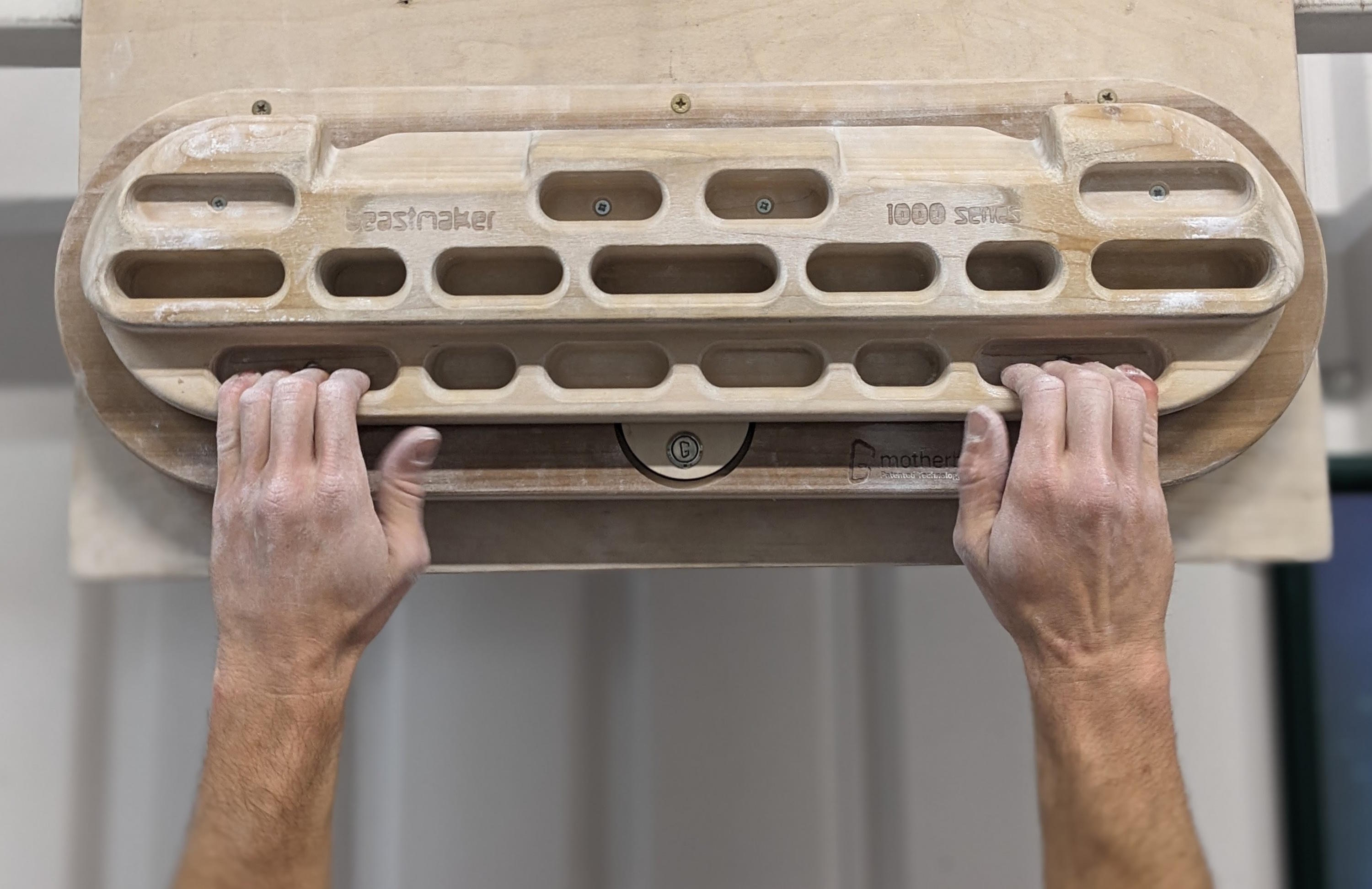
#5. Max hangs
- ✅Builds power & strength
- ✅Not too time consuming, 20 - 60mins
- ✅Can do at home
- 🛑Higher risk of injury
- 🛑Bit boring
- 🛑Need access to various weights
This is a tried and tested way to improve strength. It's essential to be fully warmed up before starting max-hangs, because they will push your body to its limit in order to cause muscles to adapt and strengthen / grow.
Essentially pick an edge and a weight and a hold type you can hold for 5 to 12 seconds, hang then rest for 2 to 3 minutes and repeat 3 to 5 times. Then choose another hold type & weight combination and do the same set of 5 to 12 seconds on, 2 to 3 mins rest repeated 3 to 5 times. You can train up to 5 hold types in a session.
I believe that if people want to train pure power, their rests are not long enough and they end up working on more short power endurance. Power training is actually really boring: you should not feel tired, the exercise should be short and with at least 3 minutes rest
This is something used by many top climbers and they all have their own tweaks and nuance to how they do it. Ned Freehaly has a few variations in his book Beastmaking. Ned prefers a variation with longer hangs of up to 20 seconds.
#6. Campus boarding
- ✅Quite quick 10 - 20mins
- ✅Builds power / strength
- 🛑Higher risk of injury
- 🛑Need a gym with a campus board
Campus boarding was developed by the aforementioned Wolfgang Guillich, who is also famous for saying:
There is no such thing as too much power
.
The campus board requires the climber to move up and down a set of rungs without using their feet. This trains explosive movement and coordination and was a key method Wolfgang used to train for the route Action Direct. The board can be used in different ways from double dynos (both hands leave a rung and land on a new rung together) to static lock offs (pull up, lock the arm and reach up with the other hand).
There is no doubt this can be an effective routine but it is also quite specific and geared to a harder level of climbing than the average person will be doing. The intensity and impact can also lead to injury from those who are not used to it, not warmed up or have poor technique. I suspect the flamboyant nature of the training makes people competitive and more likely to push into bad technique to achieve their campus goal and therefore injury happens more often. Just a theory.
I've not used a campus board in years and don't feel disadvantaged for not doing so. One consideration in its favour might be if you have a problem with "explosive" power or quick movements like pulling up to a hold using momentum to reach it rather than "slow" strength. The need for this kind of movement is rare in long “onsight" outdoor climbing in the "Victorian grades" (Diff to HVS / difficult to hard very severe). I.e. you don't know where the holds are or how good they are, so are unlikely to be using momentum to get there. That said, doing it well, campus boarding is a great way to get strong.
#7. Rock rings
- ✅Quick at ~10mins
- ✅Can do at home
- ✅Works lots of muscles
- 🛑Anecdotally easier to get injured
Using rock rings, i.e. climbing edges swinging from rope like a gymnastics rings, means a lot more supporting muscles need to be engaged when doing a work out/session. Things like L sits, chin ups and plain old hangs will strengthen the core and train the fingers and back.
The metolious rock rings have a lot of options for training plans, but their original 10 minute work out is pretty good. We made a digitised version of the rock ring work out, and made a slightly easier and slightly harder variation (in the options).
The downside to rock rings is, anecdotally the chance if injury is a little higher than a fixed edge, perhaps because poor form is more likely when tired on something that swings.
Incorporating some of these quick 10 minute work outs into the week is however pretty easy and most people should be able to find a spot to hang them.
An Australian climber, Ian Elliott, who climbs grade 28 (around 7c) at the age of 72 can be seen using rock rings in his training.
#8. Feet on hangs / "no hangs" / Abrahangs
- ✅Quick at just under 10mins
- ✅Can do at home
- ✅Safe
- ✅Can do when traveling
- 🛑Hard to get intensity right
This routine became a bit of an internet sensation with videos from many people getting well over 1 million views and reporting great results. I like this workout because it's quick at 10mins, and has a very low chance of injury, and if anything, it helps strengthen tendons against injury.
Essentially the workout is 10 seconds "hanging" 20 seconds rest for 10 minutes using progressively less fingers. However your feet stay on the floor and take some of the weight so the fingers are never fully loaded. Typically starting with 90% weight on your fingers on the easy 4 finger hang, dropping to 50% or less as you "hang" with less fingers meaning your feet take more/most of the weight at the end.
Many people have reported great results from doing this twice a day (at least 6 hours apart) for several weeks. An analysis study also highlighted good results, however I would take this lightly given the dubious methodology used, all it really confirms is “no hangs" don't seem to harm strength gains. Two things to point out are, this is 2 hours and 20 mins a week which is not an insignificant commitment (2h 20m extra of any training a week, will likely help improve your climbing). Also the last 8 "hangs" are 2 fingers hangs, so depending on how much weight you allow your feet to take will radically vary the intensity. Two people doing the same routine could have very different results depending on if the last hangs are close to the maximum of what they could hold or a casual finger stretch.
Another advantage of this routine is you can take portable edges with you when traveling and hang them up or even stand on them and pull up to get the same sort of work out.
Conclusion
I think the best training for climbing is just climbing.
I wanted to write this blog post to consolidate my research into training methods and share what I'm finding helpful. Ultimately it is my view that climbing is the best way to get good at climbing. Dave's 3 x 40mins or Adams 4x4x4's or Stefanos doubles or his bouldering with clips are all great options to structure a climbing session.
I find Rock rings and no hangs are good for when I can't get enough sessions on the wall or I am time poor or want to top up, or try to maintain performance. For me the short nature of them works well to add training around working from home or traveling for work.
The max hangs and campus board sessions are pretty rare for me because I rarely need to push my strength when doing long multi-pitch climbs, it's typically an easier grade and so more power, whilst not harmful, is also not needed in 99% of what I like to climb.
I'll end with a quote from Alex Megos who is another of the strongest climbers in the world.
Go climbing! And for the first five years or so don't even bother with specific training. Specific training is the last part of the way to becoming strong.
If you found this helpful, want to add or share something then please do email me on multi-pitch@outlook.com.